Ceremony-
Historically, Celtic weddings have been simple and meaningful, and often took place outside with nature to bless the union. Nature is very important to the Irish people, as they believe that one's soul resided both inside and and outside of the body, manifesting in the trees, rocks, waters and even the sun. Humans are intertwined with nature, and their souls are tied to the spirit of the Earth (think Avatar). When two people marry, it is believed that their strengths double and hardships divide in half, uniting their hearts, their minds and their souls forever. Today, many Irish wedding ceremonies do take place in a church, and many still take place outdoors. That's up to the bride, groom and their families.

Harp and Bagpipes-
The harp was the the national emblem of Ireland from early times to the end of the 19th century. Some brides and grooms choose to honor this by incorporating traditional Irish music played by a harpist before the ceremony. Alternately (or in addition), many big Irish families have family members who are in pipe bands, so it's not unusual for them to play as the couple comes into the mass or dinner.

Bride-
Did you know that the word Bride is actually Celtic in origin, coming from the goddess Brigid of Celtic lore?

Historically, a bride would be veiled on her wedding day to hide her away from evil spirits and fairies, who might carry her away and take her beautiful dress. A veil also represents purity and chastity. This is a very old tradition and has been used worldwide. In Irish culture, it is believed that a girl is just a maiden until she wears her veil, at which time she becomes a goddess in her own right, taking on her mystery and feminine powers. When she is unveiled by her groom, she returns to the world changed as her new life is about to begin.

Where to Stand-
The bride usually stands to the groom's left during the ceremony. This comes from a time when brides were by capture rather than consent. It is said that the groom could free his right arm to fight off the bride's family and any warriors with his strong right arm.

Irish Wedding Coin-
After the blessing of the rings, the groom presents his bride with a silver coin and says, "I give you this as a token of all I possess". The coin symbolizes his willingness to share all that he has with his bride in the future. The coin is kept as a family heirloom and is passed down from mother to her eldest son on his wedding day.

The Salt Ceremony/Salt Covenant-
This ceremony has been incorporated into Irish weddings for centuries, and has trickled into the mainstream as a popular way for brides & grooms to display their unity no matter their backgrounds and faith. In Ireland, salt is chosen for its purity, permanence and binding nature. It also (of course) represents luck! It represents the commitment of these two individuals to each other and symbolizes that their bond can never be undone. The bride and groom each hold a jar or cup of uncolored salt, and simultaneously pour it into a larger container. This symbolizes that each person's salt can never be separated or distinguished from one another again, much as their commitment to each other before God can never be broken.

Handfasting-
This ancient Celtic tradition is found in Irish, Scottish and Welsh weddings and is another source of the expression "tying the knot". In Ireland, the bride and groom cross their wrists and hold hands, creating the infinity symbol. The priest may connect their hands to his own, representing the trinity of marriage: man and woman joined by God, although typically it is just the bride & groom's hands involved. Then ribbon is wound around their hands, representing the coming together of the couple at the start of their marriage and the agreement to spend their lives together. See African Wedding Traditions, Italian Wedding Traditions and Indian Wedding Traditions for other cultural Tying the Knot rituals!

Traditional Wedding Vow-
By the power that Christ brought from Heaven, mayst thou love me.
As the sun follows its course, mayst thou follow me.
As light to the eye, as bread to the hungry, as joy to the heart, may thy presence be with me,
Oh one that I love, till death comes to part us asunder.

Church Bells & Make-up Bells-
The chime of church bells is said to keep evil spirits away and remind the married couple of their wedding vows. Long ago when Irish weddings were small and simple and the ceremony could not take place in a church, the gift of a small bell acted as a substitute.
Receiving bells as a gift is a traditional part of the Irish wedding. The couple rings the bell together after reciting vows, and as they venture into married life, they keep it in a safe place in their home; If they should argue, one of the newlyweds can ring the bell as a way to end the fight and make a truce, reminding them of their wedding vows.
It's very common to incorporate bells throughout the wedding ceremony and some couples even give small bells to their guests to ring at certain points during the ceremony and/or when they exit the church in lieu of confetti. If you're planning to do this, you may want to have an explanation in your program of when they should be rung. Guests can even ring them at the reception instead of clinking on glasses. Sometimes, bells are incorporated into wedding decor, such as mini bell place card holders and candle holders/vases.

The Pebble Toss/Wishing Stones-
The Celts often celebrated a wedding in an open area or beside a river, lake or well. All of the guests would cast small pebbles into the water and make a wish for the bridal couple. Today, there are countless variations on this custom that you can incorporate into your Irish wedding, from using a 'wishing jar' if the wedding is indoors, to a wishing stone "guest book" (stones on which guests write their messages of good luck for the couple), to using stones as place cards for the reception. Personally, I like the original version best- if you have access to an outdoor source of water and your guests can cast their wishes, I think that's the most beautiful, powerful way to do it!
The Celts often celebrated a wedding in an open area or beside a river, lake or well. All of the guests would cast small pebbles into the water and make a wish for the bridal couple. Today, there are countless variations on this custom that you can incorporate into your Irish wedding, from using a 'wishing jar' if the wedding is indoors, to a wishing stone "guest book" (stones on which guests write their messages of good luck for the couple), to using stones as place cards for the reception. Personally, I like the original version best- if you have access to an outdoor source of water and your guests can cast their wishes, I think that's the most beautiful, powerful way to do it!


The Oathing Stone-
An ancient custom in Europe was for a King to be sworn in as the new leader adjacent to certain ritual stones. To take such an oath or binding promise near an ancient stone was to make a lasting commitment, hence the term "Carved in Stone". Today, some couples choose to make their vows to each other over their own Oathing Stone in a beautiful, moving part of their ceremony.

Long ago in Ireland, the bride walked to the ceremony with her father, and returned home with her husband. They often returned on a different path, symbolizing the new road in life that they are about to travel together.

 Good Luck/Bad Luck- The Ceremony
Having a woman be the first to congratulate the bride is bad luck. If a bride's wedding dress is torn on the day, it is said to be lucky. After the ceremony, it is good luck for somebody to throw an old shoe over the bride's head, although today, rice or confetti are a more popular alternative.
Reception-
The Food-
Some Irish brides and grooms choose to serve traditional Irish fare at their weddings, while others go for a standard protein+starch+vegetable meal option. The meal itself is often memorable, hearty and delicious and prepares guests for a night of drinking and dancing!
If you are looking to incorporate popular Celtic fare, consider an Irish stew, bacon & cabbage, Shepherd's Pie, bread pudding, soda bread, or potato soup. While "Celtic" is typically a description of Irish culture, it also extends to Scotland, so traditional Celtic cuisine is composed of both Scottish and Irish dishes, including sheep, cow, fish, pork and lamb. Potatoes are the cornerstone of this cuisine and make a statement when served in traditional ways such as colcannon (a mix of potatoes and cabbage) and boxty (potato pancakes). You may even want to incorporate your favorite Irish American meal of corned beef and cabbage, although bacon & cabbage is more popular in Ireland. Having your celebration earlier in the day? Consider eggs baked with Irish bangers (a pork sausage) and cheddar, with an Irish brown bread on the side. This post by Celticweddingrings.com is helpful for anyone planning a get-together that involves a meal, Irish or otherwise.

Stocking the Bar-
An Irish proverb states, "An Irishman is never drunk as long as he can hold onto one blade of grass and not fall off the face of the Earth." Plan accordingly for an Irish wedding, stocking plenty of Guinness, Bailey's Irish Cream, and Jameson, among other spirits for such a spirited occasion!
The toasts to the happy couple are often completed with champagne today, but in the seventeenth century in Ireland, this was in short supply. For many, Poteen-- a very strong whiskey made from potatoes-- was the drink of choice. The flavor and recipe often varied from village to village depending upon the type of potato and skill level of the person doing the refining.

Mead(e)-
It is traditional to raise a glass of honeyed wine, or mead, to the couple at the end of the wedding feast. Mead is an Anglo-Saxon drink originally made by Monks and is served today as a 'traditional' Irish drink due to its popularity over time. Bunratty Mead seems to be the mead of choice these days, and they even make little airplane bottles, so they make a really sweet wedding favor!

The Quaich-
The Quaich (pronounced almost like "Quake" but with a throaty ch at the end- think 'Ch in Chanukah') is a double-handled bowl or goblet that is sometimes referred to as the loving cup of the friendship cup. It requires two hands to drink, so enemies cannot reach for a weapon while drinking, and its two handles make it ideal for sharing. At a wedding, this symbolizes the joining of the families, and oftentimes the parents, the bride and the groom will take a sip from it. It can be made of wood, pottery, silver or pewter, can come in a variety of sizes and can be decorated or plain. Want to learn All About that Quaich? This site is fantastic!

"Slainte," pronounced SLAW-in-tche, is a popular Irish toast that literally translates to "health". There are a few variations, including "Good health", "Your good health", and "On your health" among others, and they are often used as drinking toasts in Ireland and Scotland.

Saving the Champagne- In some regions of Ireland, it's customary for a bottle of champagne to be saved from the wedding reception and opened when a child is brought into the marriage. "Wetting the baby's head" at the Christening has dual meanings: the application of water from the Priest, and the celebration of the occasion with a drink.

Irish Wedding Blessings-
Honestly, I think the toasts and blessings are among the most glimmering gems I've found when it comes to Irish weddings. I know that Irish blessings are special, and that they often rhyme, but I don't think I realized quite how many of them there are for weddings, and just how amazing they are!
When it comes time for toasts at an Irish wedding, oftentimes a male family member will toast the couple first. The bride's father will then toast the couple, the couple will toast their guests, the groom may present a thank you gift to his mother and mother-in-law for helping with the reception, the wedding party may toast the couple, and the couple may toast the person who introduced them (originally a custom reserved for a matchmaker). The Best Man often toasts the couple, and the Maid of Honor may do the same. Here are a few blessings that can be incorporated into a great toast:
~~~~~
May love and laughter light your days, and warm your heart and home.
May good and faithful friends be yours, wherever you may roam.
May peace and plenty bless your world with joy that long endures,
May all life's passing seasons bring the best to you and yours.
~~~~~
May your troubles be less and your blessings be more
and nothing but happiness come through your door.
~~~~~
Don't walk in front of me, I may not follow
Don't walk behind me, I may not lead
Walk beside me and just be my friend
- Old Irish Proverb
~~~~~
May you be poor in misfortune, Rich in blessings
Slow to make enemies, Quick to make friends
But rich or poor, quick or slow,
May you always know happiness from this day forward.
~~~~~
May your troubles grow few as your blessings increase,
May the saddest day of your future,
be no worse than the happiest day of your past.
May your hands be forever clasped in friendship
and your hearts joined forever in love,
Your lives are very special,
God has touched you in many ways,
May his blessings rest upon you
and fill all your coming days.
~~~~~
May God give you...
For every storm, a rainbow,
For every tear, a smile,
For every care, a promise,
And a blessing in each trial.
For every problem life sends,
A faithful friend to share,
For every sigh, a sweet song,
And an answer for each prayer.
~~~~~
May the road rise to meet you.
May the wind be always at your back.
May the sun shine warm upon your face,
The rains fall soft upon the fields.
May the light of friendship guide your paths together.
May the laughter of children grace the halls of your home.
May the joy for one another
trip a smile from your lips, a twinkle from your eye.
And when eternity beckons,
at the end of a life heaped high with love,
May the good Lord embrace you
with the arms that have nurtured you
the whole length of your joy-filled days.
May the gracious Gold hold you both,
in the palm of His hands,
and, today, may the Spirit of Love
find a dwelling place in your hearts.
~~~~~
Wishing you a rainbow,
for sunlight after showers-
Miles and miles of Irish smiles
for golden happy hours-
Shamrocks at your doorway
for luck and laughter too,
And a host of friends that never ends
each day, your whole life through!
~~~~~
Bride & Groom:
"Friends and relatives, so fond and dear, 'tis our greatest pleasure to have you here. When many years this day has passed, fondest memories will always last. So we drink a cup of Irish mead and ask God's blessing in our hour of need."
The Guests Respond:
"On this special day, our wish to you, the goodness of the old, the best of the new. God bless you both who drink this mead, may it always fulfill your every need."
~~~~~
St. Patrick was a gentleman who through strategy and stealth,
drove all the snakes from Ireland, here's a toasting to his health.
But not too many toastings lest you lose yourself and then,
forget the good St. Patrick and see all those snakes again!

For more, visit PartySimplicity's St. Patrick's Day Wedding post- it's full of great information and inspiration!
Also, lollysmith.com has an amazing collection of toasts and blessings!
First Dance-
This tradition is widespread around the world, and involves the bride and groom dancing to start the evening. This can be a traditional Irish dance to the tune of traditional Irish music played by your band, DJ or even Irish pipers (playing bagpipes), or a slow dance to the song of their choosing.

Entertainment-
Music or entertainment is then provided to start the party. This can be anything from a talented family member or friend, to a professional singer or Cabaret act or even some Irish dancers.
Want to see some fun videos of Irish dancing at weddings? This Groom and his guys even surprised wedding guests and the bride with this dance, and you'll be amazed by this surprise dance from the wedding of 2 former Riverdance dancers. Can you imagine being at these weddings?!
Usually a DJ or live band round off the evening with plenty of dancing and the bars stay open, keeping the alcohol flowing.

Cake-
The Irish wedding cake is traditionally a hearty fruitcake made with honey and soaked in (what else?!) an Irish whiskey, then frosted with a sweet white glaze. This may need to sit for several months, depending upon the recipe, so brides and grooms must work with bakers to plan accordingly.
It may be a 3-layer cake, and may be filled with almonds, raisins, cherries and spice, laced with brandy or bourbon with almond paste between each layer. In this case, the top layer is the whiskey layer and will be saved for the Christening of the couple's firstborn child. One slice of the 1st or 2nd layer is saved for the couple's first anniversary.
A bride's cake is also served to the single ladies. A trinket, such as a silver Claddagh or Celtic design ring, is hidden under the top layer of frosting. The young lady who receives that slice is said to be the next bride, similarly to the throwing of the bouquet in other cultures.

Tossing of the Bouquet- Interestingly, the bride does toss her bouquet to her unmarried friends as well, wishing them extra luck and giving another chance to be the next to marry! This does not have Irish origins, but is often done in many regions around the world.
 Good Luck/Bad Luck- The Reception-
It's okay for the bride and groom to wash their hands on their wedding day, but washing them together in the same sink is bad luck. Because fairies love beautiful things-- brides and their lovely gowns among them-- a bride must be careful not to lift both feet off of the floor while dancing, so that the fairies don't lift her away!

After the Wedding:
Breaking the Cake/Bread-
Any new mother-in-law should note that to ensure good relations with her new daughter-in-law, all she has to do is (gently) break a piece of the wedding cake or a piece of bread over the Bride's head as she enters her house after the wedding. This is done as a token that the bride will take over as the woman of the house.

Honeymoon-
In Gaelic, "honeymoon" is "mi na meala", meaning "the month of honey". Long ago, it was customary for the newlyweds to spend a month alone drinking mead. The sweet wine is said to bring success and luck to the couple, as well as to boost fertility; Babies born nine months after the wedding were attributed to the mead! Guests would bring mead to give the couple as a wedding gift, and it would provide for their honey month :) I think this is my favorite honeymoon-tradition-origin story yet!

Tips if You're a Guest at an Irish Wedding-
1. If the wedding is outdoors, be sure to wear comfortable shoes.
2. Eat a big breakfast. It could be awhile before dinner, and you want to prepare your body for the liquor and beer you'll be consuming later.
That's all :)

Want to Learn More?
Given Ireland's long history, and the number of years during which weddings had to be conducted quietly, it's not surprising that there are so many different wedding traditions and superstitious beliefs. Some have come and gone, and some are only seen in specific regions of Ireland, while others are practiced around the world. There are so many traditions and customs that it is really up to the bride and groom to decide what they would like to incorporate. They may have an ode to Ireland in the form of an ice sculpture (like those below) or they may do their own thing! In any case, thanks for checking out Wediquette's post. Feel free to visit the Wediquette Irish Wedding Traditions Pinterest page for more and share any other information or traditions you know in the comments below! Thanks!!
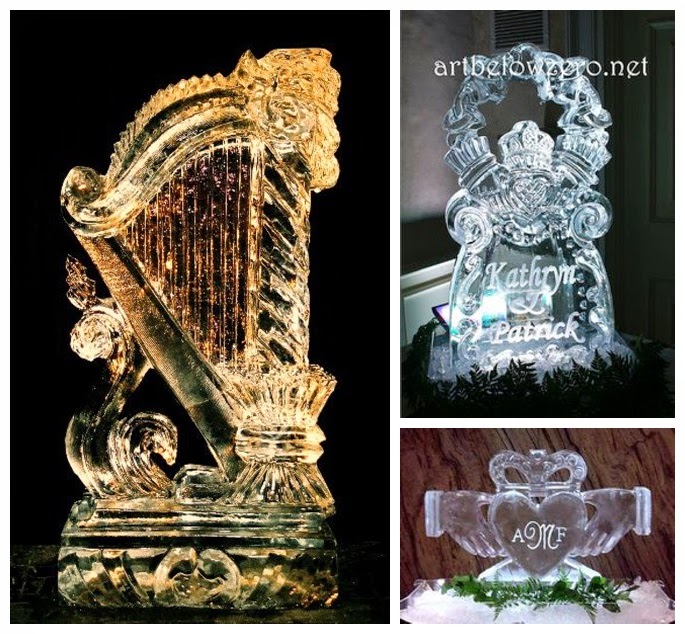
Here are a few other sites with lots of great information for Irish weddings:
http://www.gaelicmatters.com/irish-wedding-customs.html
http://www.ireland-information.com/articles/irishweddingtraditions.htm
http://www.bridalguide.com/blogs/bridal-buzz/irish-wedding-traditions
http://www.abcteach.com/free/r/rc_irish_history.pdf
By the Way...
Want to learn more about other awesome cultural traditions and customs around the world? Check out these other Across the Board posts and let me know if you have a request for the next one:
Jewish Wedding Traditions
African Wedding Traditions
Italian Wedding Traditions
Indian Wedding Traditions
Polish Wedding Traditions
Greek Wedding Traditions Part 1 and Part 2
Are you putting together bathroom baskets for an upcoming wedding or party? Click here for information and inspiration!
Are you in a wedding party and not sure what to do next? Check out this post for info on what to do next!
Looking for the best wedding tunes? Click no further!
Planning an Engagement Shoot? Check out the 5 W's and pics of some of my favorite people at theirs!
This post about wedding cakes is my sweetest one yet!
Putting together your seating chart? Prepping place cards? Want to make your own card box? Wediquette can help!
Note: All photos in the Across the Board series have been spotted through Pinterest and/or Google. Most have been pinned with a direct link to their original website on the Wediquette pinterest page. I love learning about and sharing cultural traditions, so I thank the sources for sharing and hope there aren't any hard feelings for reposting!


